








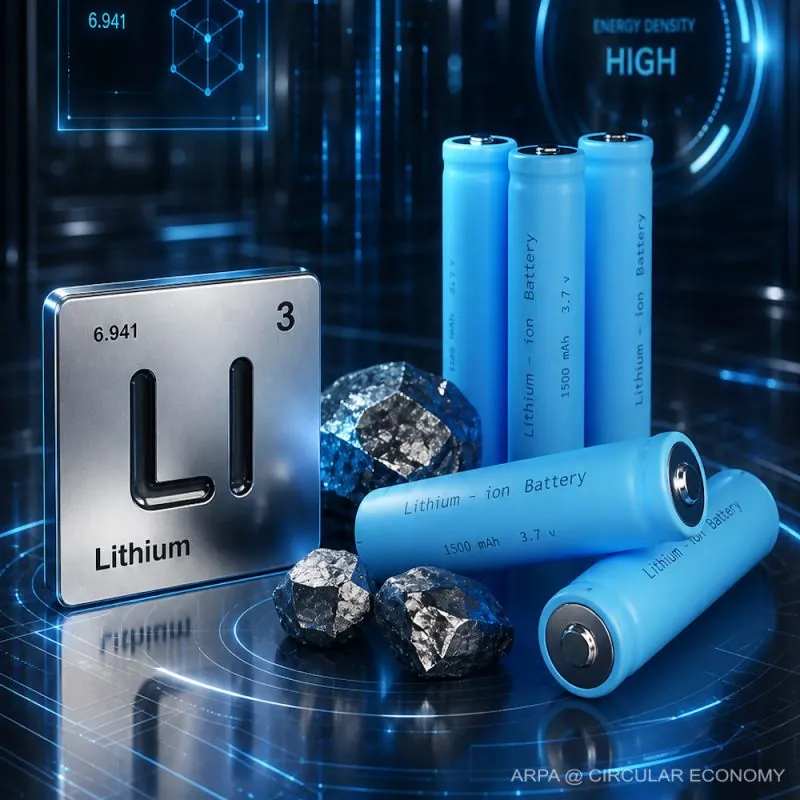
Modern waste management is increasingly becoming a question not only of recycling efficiency, but also of fire prevention. One reason is small, often almost invisible: the growing number of lithium-ion batteries entering ordinary waste streams.
On 17 July 2026, firefighters in Almaty responded to a fire in a warehouse containing lithium-ion batteries and electric scooters. According to Kazakhstan’s emergency services, a battery block had caught fire, creating the risk that the flames could spread to neighbouring batteries and hundreds of stored scooters. Firefighters removed around 300 scooters and more than 100 batteries from the danger zone while intensively cooling the affected battery units. This was not a waste-management incident. But it illustrates a problem that becomes even more difficult once lithium batteries disappear inside mixed municipal or commercial waste. A battery thrown into an ordinary waste bin may subsequently pass through collection vehicles, compactors, transfer stations, sorting equipment and shredders. If damaged or crushed, a lithium-ion cell can enter thermal runaway and ignite surrounding paper, plastics and other combustible material.
The U.S. Environmental Protection Agency documented 245 fires caused or likely caused by lithium batteries at 64 waste-management facilities and vehicles in an earlier multi-year study. The incidents occurred across recycling plants, garbage trucks, transfer stations and landfills. The common problem was mechanical damage to batteries inside waste-management processes that were never designed to handle them.
The European Commission highlighted the same issue again in July 2026, noting that incorrectly discarded small lithium-ion batteries are causing an increasing number of fires in waste-treatment facilities.
For Central Asia, this deserves attention. The region is simultaneously experiencing increasing consumption of electronic devices, electric mobility, industrial modernisation and growing pressure to improve municipal waste-management systems. At the same time, recent events demonstrate how demanding waste fires can already become.
On 10 July 2026, a major fire broke out at a municipal solid-waste landfill in Astana. Around 100 emergency personnel and 47 pieces of equipment were initially involved. The fire ultimately affected approximately three hectares, and around 15,000 tonnes of inert material were used during the extinguishing and containment work. No public authority attributed this particular fire to lithium batteries, but the incident illustrates the scale of operational and environmental consequences once fire develops inside a large mixed-waste facility.
The conclusion should therefore not be that better firefighting alone is required. The more fundamental challenge begins earlier. Batteries should not enter the ordinary waste stream in the first place. That means developing separate collection systems, public awareness, safe interim storage and dedicated recycling routes. But modern recycling facilities also need to assume that some batteries will nevertheless arrive. This creates demand for additional layers of technology and operational know-how: battery and e-waste separation, advanced sorting, early fire and heat detection, protected storage areas, fire-suppression systems, safe shredding concepts and better monitoring of material flows.
For AETEK, this is an interesting example of how environmental infrastructure is changing. Waste management in Central Asia will increasingly be about more than trucks, landfills and conventional sorting lines. It will require the integration of European recycling technology, fire-safety concepts, process know-how and specialised equipment into increasingly complex local waste systems. This is precisely where industrial business development becomes relevant. The challenge is not simply to identify a machine and export it. It is to understand the local waste stream, the operator, the regulatory environment and the actual operational risk — and then connect that requirement with the right technology and implementation partner. Lithium batteries are therefore a relatively small component of the waste stream. But they illustrate a much larger development.
Central Asia modernises its recycling infrastructure, the quality and safety of the entire waste-management system will increasingly depend on technologies that can identify, separate and safely manage what conventional waste systems were never designed to handle.