
Finding the plants that are investing
Which producers are expanding, replacing equipment or under pressure to improve quality — and which are only talking about it.
Machinery, process equipment, automation and measurement for plants that are being modernised
Across the region, production lines built decades ago are being replaced. The machines are bought abroad — and the supplier who is present when the budget is approved is the one who supplies them.
Modernisation is not a trend here, it is a necessity: equipment reaches the end of its life, energy costs rise, and export customers demand consistent quality.
The buyers are food and beverage producers, building materials plants, chemical and fertiliser works, metal processing, packaging, textiles and an expanding group of private manufacturers. They rarely buy a single machine: they buy a line, commissioning, training and the promise that someone will answer the phone when it stops.
European suppliers win on process reliability, energy efficiency and service quality. They lose on delivery times, on price when the specification is written loosely, and on silence after the first enquiry.
Special and free economic zones attract most new factories, with tax and customs incentives. Each zone needs different technology — filter by what you supply.
The capital's zone for construction materials, machinery assembly and food — a city that keeps building.
 Kazakhstan
 The technology park near Almaty for IT, electronics and engineering companies.
Kazakhstan The "Eastern Gate" on the Chinese border: a dry port where containers change gauge, plus warehouses and an industrial zone.
Kazakhstan The seaport zone on the Caspian: port logistics, building materials and plastics on the Middle Corridor.
Kazakhstan The national petrochemical technopark, with Kazakhstan's first large polypropylene plant.
Kazakhstan A zone for chemicals and petrochemicals next to the refinery and the aluminium industry.
Kazakhstan The textile zone of the south, close to the cotton regions — spinning, weaving and finishing.
Kazakhstan Uzbekistan's first free economic zone (2008), next to an international cargo airport: electronics, pharmaceuticals and machinery.
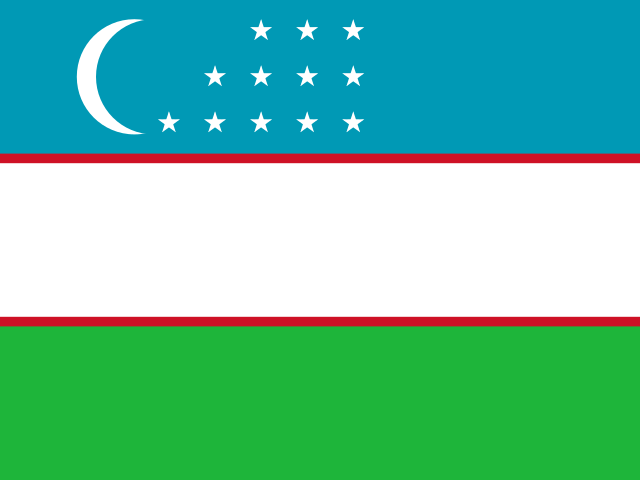 Uzbekistan
 The IT park with tax incentives for software companies, and industrial zones for machinery and electrical engineering.
Uzbekistan A zone in the coal and metals region east of Tashkent, with a logistics centre on the railway towards the Fergana Valley.
Uzbekistan Assembly, light industry and warehousing, with duty-free access to the Eurasian Economic Union.
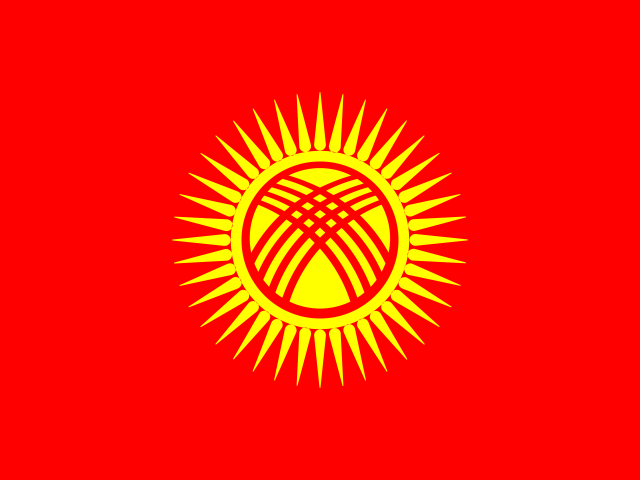 Kyrgyzstan
 Tajikistan's zone in the north, at the entrance to the Fergana Valley: food, textiles and building materials.
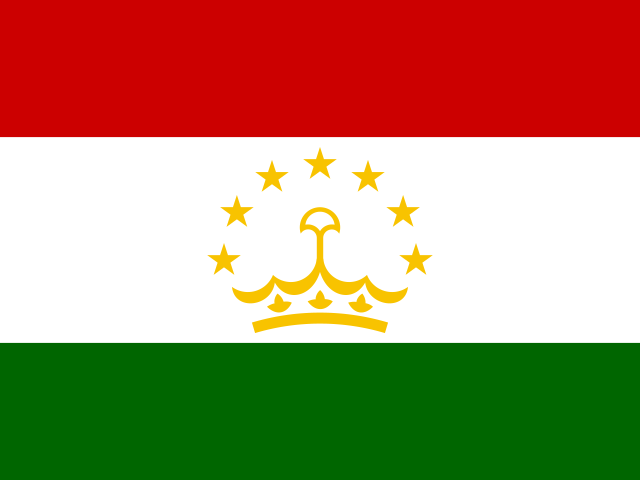 Tajikistan
 The international seaport on the Caspian (opened 2018) and the gas-chemical complex at Kiyanly nearby.
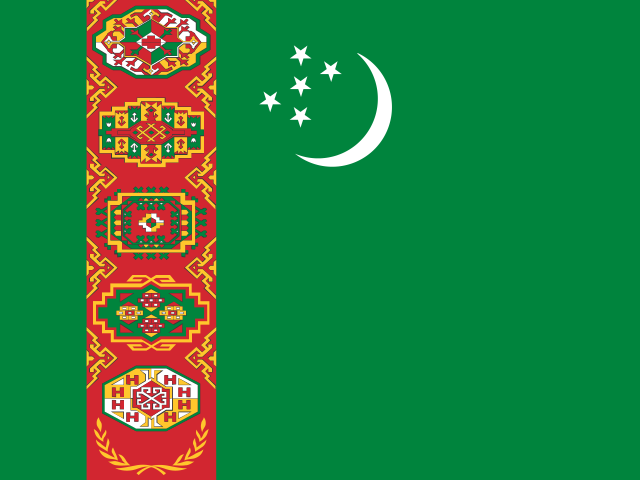 Turkmenistan
 A selection of zones; positions are approximate.
Which producers are expanding, replacing equipment or under pressure to improve quality — and which are only talking about it.
In mid-sized industry the owner often decides personally. Reaching that person is a different exercise from filling in a tender portal.
Helping the customer describe what they actually need, so your offer is not compared against something cheaper that cannot do the job.
Operator training, commissioning support and spare parts logistics — frequently the decisive difference against a cheaper competitor.
Local system integrators and dealers who can install and support your technology, selected on capability and checked on site.
Offer clarification, price and payment discussion, and the persistence it takes between the quotation and the purchase order.
A typical production hall, from raw material to the packed product. Select a point to see what buyers ask for there — and where European suppliers usually win.
Answer five short questions about your situation. The bars show which of the three ways to start fits best, and change with every answer.
A first orientation, not advice. Before anything is recommended, we look at your case in detail.
Not on price. On total cost: output, energy consumption, downtime, spare parts and the lifetime of the line. That argument only lands if someone makes it in person, in the customer's language.
Sometimes — and then we say so. More often the issue is that the few relevant plants have never heard of you, which is a different and solvable problem.
In Uzbekistan increasingly, in Kazakhstan for larger projects. It is negotiable, and it is often what turns a quotation into a long-term position.
For operating and maintenance documents, yes, and usually for the offer as well. It is a small investment that removes a large objection.
Tell us what you build. We will come back with an honest first assessment of the fit.
Industrial Technology — Central Asia
From market potential to business.
Describe your machine or line, the industries it serves and the typical order size. We will tell you where it fits in the region.
Prefer email? info@aetek.eu
Amtsgericht Aschaffenburg
HRB 14157
DE288091462
DE644795536634916
AETEK® is a registered word mark of AETEK GmbH, German Patent and Trade Mark Office (DPMA), Reg. No. 30 2023 202 928 (expires 31 Jan. 2033). View registration certificate (PDF)
Legal Entity Identifier (LEI) 391200MNLJ2E0R0I6V98, issued 16 Aug. 2021 by Bundesanzeiger Verlag. View in GLEIF register
AETEK company flyer 2026 – Business Development as a Service, in English. View flyer