

Market and project intelligence
Modernisation programmes, industrial projects and import demand in the segments that match your technology — including who is financing them.
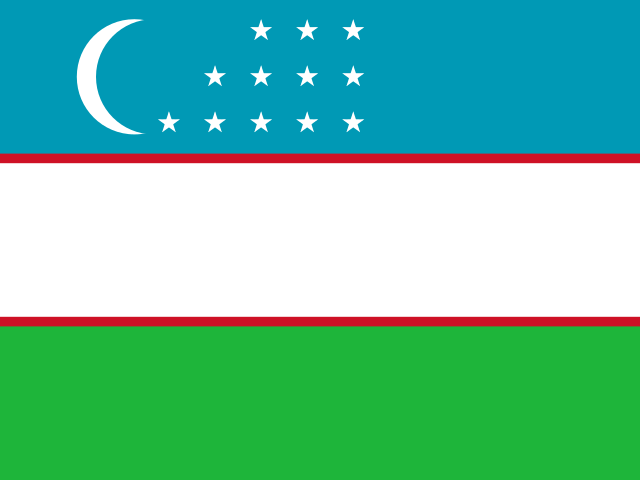 Uzbekistan · Oʻzbekiston
Market entry and business development for European industrial companies
With 37 million people and an industrial base that is being modernised with imported technology, Uzbekistan is the second market European suppliers should look at in Central Asia — and increasingly the first.
Sources: National Statistics Committee (population, 1 Apr 2026; industrial firms, 1 Dec 2025; imports, Jan–Sep 2025)
Uzbekistan is the most populous country in Central Asia and the one with the broadest manufacturing base. Machinery and equipment account for about a third of all imports — a direct indicator of demand for European technology.
Roughly 60,000 companies are registered in industry, from large state-linked groups in mining, chemicals and energy to a fast-growing base of private producers in textiles, food processing and building materials. Many of them are replacing outdated equipment and looking for suppliers who can deliver technology, training and service together.
Localization is a recurring theme: customers frequently ask for local assembly, technology transfer or a service presence as part of the deal. Handled well, this is an advantage for European suppliers rather than an obstacle — but it has to be negotiated with the right people, in the right order.
From the first structured look at the market to a signed contract — carried out on the ground, in the languages the business is done in.
Modernisation programmes, industrial projects and import demand in the segments that match your technology — including who is financing them.
Named producers and operators with a real need for your equipment, qualified before the first trip to Tashkent or the regions.
Owners, technical directors and procurement heads — plus the ministries and agencies that shape larger industrial projects.
Local partners that can sell and service your product, checked for capability, portfolio conflicts and the willingness to invest in the brand.
When customers ask for local assembly, service capability or technology transfer, we structure what is realistic — and what should stay in Europe.
Offers that fit local requirements, negotiation support and the commercial terms — payment, delivery, warranty and service.
Uzbekistan's industry lines up along the old caravan route. Seven stops from west to east — and seven very different buyers. Filter by sector or select a stop.
Soda production and a large gas-chemical complex on the Ustyurt plateau in the far west.
Gas fields and an oil refinery around one of the oldest cities on the route.
Home of one of the world's largest gold producers, a nitrogen-chemicals plant and a free economic zone.
Food processing, building materials and vehicle production, alongside the tourism the city is famous for.
The capital and largest city: ministries, holdings, banks and much of the machinery and electrical industry. AETEK's representative works here.
One of the region's largest mining and metallurgical combines — copper, gold and zinc — in the middle of a major expansion.
The most densely populated region: textiles, food, an oil refinery in Fergana and car production in Asaka.
Uzbek industry buys from suppliers it knows. Continuity, service and visible references decide who is asked for the next quotation.
With about 38 million people, Uzbekistan is the most populous country in Central Asia — and one of the youngest. That shapes demand, and the workforce you can hire.
32 %≈ 12.4 million
Almost a third of the population is under 15 — a large market for food, consumer goods and education, and tomorrow's workforce.
15 %≈ 5.9 million
Around half a million young people enter the labour market every year. Companies that train them early find staff more easily.
39 %≈ 15.1 million
The prime working age. Many have worked abroad, in Russia or Kazakhstan, and bring that experience back.
13 %≈ 5.0 million
Only about one in eight people is older than 55 — the reverse of the age structure in Europe.
Rounded values in millions, by five-year age group.
Bring your technology into Uzbek industry: qualified customers, capable partners, and the commercial work between your organisation and the market.
Identify and qualify European manufacturers and suppliers — from technical specification and supplier search to delivery, commissioning and service.
AETEK is represented in Tashkent and works from Germany with offices and representatives across the corridor: Haibach (headquarters), Kazan, Almaty, Tashkent and Dubai. Business is done in Uzbek and Russian; we work in German, Russian and English. Our representatives also speak Uzbek.
Machinery and equipment account for about a third of all imports — strong demand for European technology.
Answer five short questions about your situation. The bars show which of the three ways to start fits best, and change with every answer.
A first orientation, not advice. Before anything is recommended, we look at your case in detail.
It is the most populous market in Central Asia, its industry is being modernised with imported equipment, and machinery already accounts for about a third of all imports. Suppliers who build relationships now are the ones quoted in the next investment cycle.
Often, yes — at least local assembly, service capability or training. It is negotiable, and in many cases it is what wins the project. We structure what is realistic for a mid-sized European supplier.
Uzbek and Russian, with English mainly in technical documentation. AETEK works in German, Russian and English. Our representatives also speak Uzbek.
It depends on your product. Mining, oil and gas and heavy equipment usually start in Kazakhstan; consumer-facing manufacturing, textiles and food processing often start in Uzbekistan. We give a clear recommendation in the fit check.
With a fit check and a shortlist of qualified opportunities, followed by a first round of meetings on site. From there it becomes normal business development work: offers, clarification, negotiation.
The neighbouring project market: Tajikistan
Tell us what you build. We will come back with an honest first assessment of the fit.
Business Development & Market Entry — Uzbekistan
From market potential to business.
Tell us which technology you want to bring into Uzbekistan and where you stand today: first enquiries, an existing partner, or a blank sheet.
Prefer email? info@aetek.eu
Amtsgericht Aschaffenburg
HRB 14157
DE288091462
DE644795536634916
AETEK® is a registered word mark of AETEK GmbH, German Patent and Trade Mark Office (DPMA), Reg. No. 30 2023 202 928 (expires 31 Jan. 2033). View registration certificate (PDF)
Legal Entity Identifier (LEI) 391200MNLJ2E0R0I6V98, issued 16 Aug. 2021 by Bundesanzeiger Verlag. View in GLEIF register
AETEK company flyer 2026 – Business Development as a Service, in English. View flyer