

Tender and programme monitoring
State tenders and investment programmes in gas, chemicals, energy and water — followed continuously, because announcement periods are short.
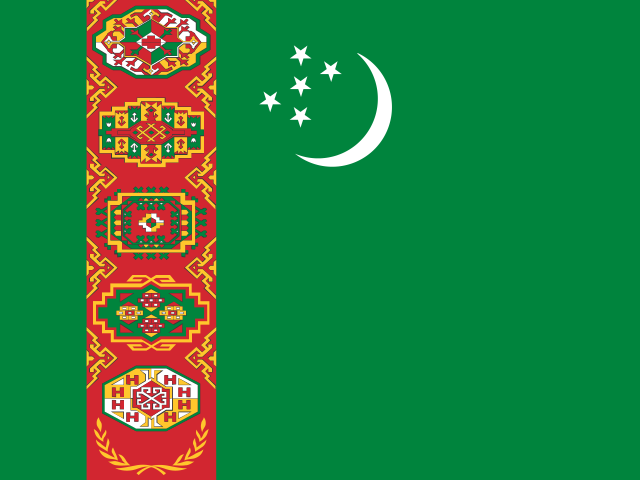 Turkmenistan · Türkmenistan
Gas, petrochemicals and textiles — the most state-directed market of the five
Turkmenistan holds the world's fourth-largest proven natural gas reserves and buys serious industrial technology. It is also the market with the most formal access rules — which is exactly why it rewards preparation.
Sources: World Bank (population, 2025) · Energy Institute, Statistical Review 2025 (gas reserves) · industrial firms: AETEK estimate
Gas and petrochemicals define the economy. Purchasing is concentrated in state structures, which makes the market formal, slow and, once entered, stable.
Gas production and processing, refining, fertiliser and polymer plants, power generation, cotton processing and textiles form the industrial core. The equipment behind them is largely imported, and European technology has a good standing in gas treatment, compressors, measurement, automation and water infrastructure.
What differs from the neighbouring markets is the process: most significant purchases run through state entities and formal tenders, contract conditions and payment arrangements need careful attention, and access for foreign companies follows its own administrative rules. None of that makes the market closed — it makes it a market for suppliers who prepare properly.
Holds the world’s fourth-largest proven natural gas reserves.
Gas is Turkmenistan's main export. Within a decade its buyers changed almost completely — which explains how the state budget, payment practice and procurement work today.
Almost all exports go north to Russia, through the pipelines of Soviet times.
An explosion on the line to Russia in 2009 cuts flows north. In December 2009 the Central Asia–China pipeline opens.
Three parallel lines to China are running. China is now by far the largest buyer.
Russia stopped buying in 2016, Iran at the start of 2017 after a price dispute — China takes practically everything.
Russia returns with a smaller long-term contract.
China remains dominant. Swap deliveries via Iran to Azerbaijan add a small new route; the TAPI pipeline towards Afghanistan, Pakistan and India is being built in sections.
Approximate shares of pipeline exports, rounded to 5 %, from public estimates.
Covered from Dubai and Tashkent, the two practical gateways into the country for European suppliers.
State tenders and investment programmes in gas, chemicals, energy and water — followed continuously, because announcement periods are short.
The formal route to state entities and their technical departments, including how a foreign supplier is expected to be represented locally.
Payment terms, guarantees and delivery conditions reviewed before an offer is made — the part where deals in this market are won or quietly lost.
Routes, documentation and the service setup for a country where support cannot be improvised from Europe.
Turkmenistan holds the world's fourth-largest proven gas reserves, and Galkynysh is one of the largest fields anywhere. Every route out is a long-term programme for compressors, gas treatment, measurement and automation.
→ Uzbekistan · Kazakhstan · China
Operating since 2009. China is today the main buyer of Turkmen gas.
→ Kazakhstan · Russia
The Soviet-era route north. Volumes are far below its former role.
→ Caspian coast
Links the large eastern fields with the Caspian coast. Completed in 2015.
→ Afghanistan · Pakistan · India
Towards Afghanistan, Pakistan and India. Under construction.
→ Azerbaijan · Europe
A proposed link under the Caspian Sea towards Azerbaijan and Europe.
Answer five short questions about your situation. The bars show which of the three ways to start fits best, and change with every answer.
A first orientation, not advice. Before anything is recommended, we look at your case in detail.
For industrial technology, yes — European equipment is bought regularly. The question is rarely the product; it is whether you are prepared for a formal, state-led process.
In practice, some form of local representation is expected. How it is structured depends on the buyer and the type of contract, and it should be clarified before the first offer.
Payment arrangements deserve early attention, including guarantees and, where relevant, export credit cover. We look at this before anything else.
No official count is published. Based on the size and structure of the economy we work with an estimate of roughly 2,000 industrial enterprises, most of them state-linked.
Tell us what you build. We will come back with an honest first assessment of the fit.
Business Development & Market Entry — Turkmenistan
From market potential to business.
Describe your technology and whether you have had contact with the market before. We will tell you what a realistic path looks like.
Prefer email? info@aetek.eu
Amtsgericht Aschaffenburg
HRB 14157
DE288091462
DE644795536634916
AETEK® is a registered word mark of AETEK GmbH, German Patent and Trade Mark Office (DPMA), Reg. No. 30 2023 202 928 (expires 31 Jan. 2033). View registration certificate (PDF)
Legal Entity Identifier (LEI) 391200MNLJ2E0R0I6V98, issued 16 Aug. 2021 by Bundesanzeiger Verlag. View in GLEIF register
AETEK company flyer 2026 – Business Development as a Service, in English. View flyer