






From Transit Geography to Industrial Value Creation - Kazakhstan has a strategic opportunity to become more than a transit country between China and Europe. Alatau City could play an important role in this transformation.
The Trans-Caspian Transport Corridor (TCTC), widely known as the Middle Corridor, is increasingly attracting international attention as an alternative trade route connecting Asia and Europe. For Kazakhstan, however, the real opportunity extends far beyond transportation volumes, railway capacity and transit revenues. It raises a much more fundamental question: How can Kazakhstan transform its geographical position into sustainable industrial competitiveness, technological development and long-term economic value? This is precisely where Alatau City becomes strategically relevant.
1. The Middle Corridor: From Connectivity to Economic Development
The Middle Corridor connects China with Europe through Kazakhstan, the Caspian Sea, Azerbaijan, Georgia and Türkiye, with additional connections across the Black Sea. Its development is supported by international financial institutions and governments seeking more diversified, resilient and efficient Eurasian supply chains. In September 2026, the World Bank published its report Integration: World-Class Trade Logistics Along the Trans-Caspian Transport Corridor. The report estimates that targeted investments and operational improvements could more than triple trade volumes along the corridor by 2040. It also identifies approximately USD 25 billion in necessary physical infrastructure investments and another USD 30 billion in complementary investments across the corridor countries.
Most importantly, the World Bank emphasizes the transformation from a transport corridor into an economic corridor - one capable of generating business activity, employment and industrial growth along its route. For Kazakhstan, this distinction is fundamental. Moving goods across a country creates economic activity. Developing industries that manufacture, process, assemble, maintain and distribute those goods creates a much broader foundation for economic development.
2. Why Alatau City Matters
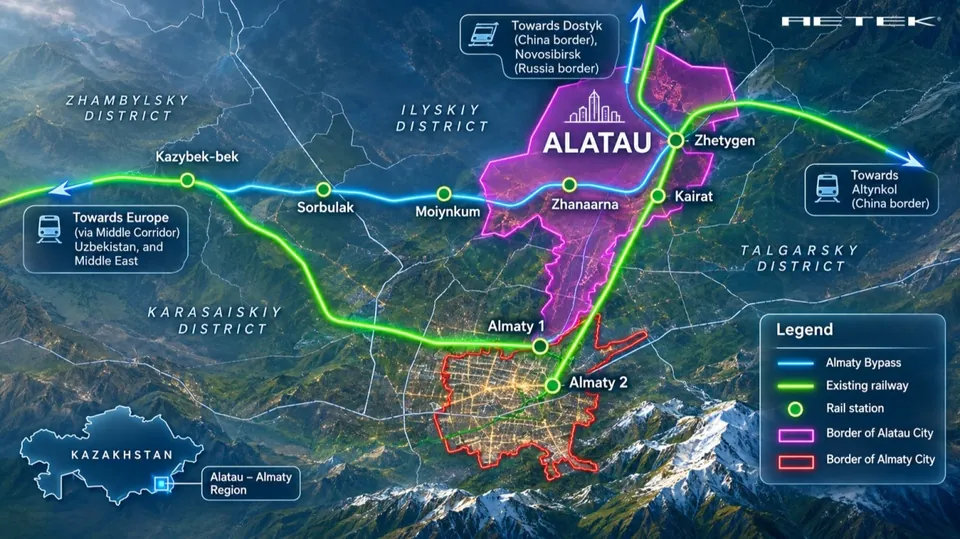
Located within the Almaty economic region, Alatau City benefits from proximity to established commercial markets, industrial infrastructure and transport connections towards China and the wider Central Asian region. Its development concept extends far beyond residential construction and urban infrastructure. The officially designated Growing District is intended to become an export-oriented industrial and logistics cluster, integrating manufacturing, modern logistics infrastructure and international market connectivity. This creates a potentially important relationship with the Middle Corridor. Alatau City could evolve into a location where international connectivity supports actual industrial operations rather than transit alone.
Several complementary activities become conceivable:
Industrial manufacturing and technology localization.
Assembly, technical service and maintenance facilities.
Regional distribution and industrial procurement.
Logistics and value-added processing.
Cross-border production and supplier partnerships.
Importantly, Alatau City should not yet be considered an established operational hub of the Middle Corridor. Its integration into international freight networks will depend on commercially viable connections, functioning terminals, infrastructure availability and reliable logistics services. Nevertheless, developments are already underway. These developments illustrate how the city's industrial ambitions could gradually acquire an operational foundation.
3. A Strategic Opportunity for Kazakhstan
The potential combination of the Middle Corridor and Alatau City could strengthen Kazakhstan's economic position in three interconnected ways.
First: Industrial diversification.
Kazakhstan could capture a greater share of economic value through domestic processing, manufacturing and industrial services instead of relying predominantly on raw material exports and transit activities.
Second: Integration into international value chains.
European and Asian technology companies could use Kazakhstan as a regional location for technical services, assembly, production and distribution serving Central Asian and potentially wider Eurasian markets.
Third: Greater economic resilience.
Diversified transport connections, industrial capabilities and international partnerships could reduce dependence on individual markets, routes and economic sectors.
The strategic importance of Kazakhstan's railway network is already reflected in the World Bank's February 2026 approval of an USD 846 million guarantee designed to mobilize USD 1.41 billion in long-term commercial financing for Middle Corridor rail connectivity improvements. This financing concerns Kazakhstan's wider railway infrastructure, not Alatau City specifically. Nevertheless, it forms part of the broader transport environment on which the city's future connectivity may depend.
4. From International Agreements to Industrial Execution
The November 2026 Alatau City investment roadshow in London, Berlin and Frankfurt provides another important signal. According to the Government of Kazakhstan, the German stage resulted in 18 agreements with an indicated investment potential of USD 715 million. Across the European roadshow, 27 commercial documents represented a cumulative investment potential exceeding USD 2 billion. These figures reflect announced investment potential rather than completed investments. The discussions in Germany included infrastructure financing, industrial cooperation, engineering systems, equipment procurement and technological partnerships. For European industry, such developments may create opportunities extending well beyond construction contracts. They could generate demand for industrial equipment, water and energy systems, environmental technologies, mechanical engineering, automation and technical services.
However, investment announcements do not automatically become executable projects. Successful implementation requires identifiable project owners, secured financing, transparent procurement structures, technically qualified suppliers and commercially sustainable partnerships. This is where structured business development becomes essential.
5. The AETEK Perspective: Connecting Infrastructure with Industrial Demand
At AETEK, we view the potential relationship between Alatau City and the Middle Corridor primarily through the lens of industrial market development. For European technology providers, new infrastructure and industrial zones do not automatically translate into accessible business opportunities. The critical work lies in identifying actual demand, understanding project ownership, establishing access to decision-makers and developing commercially viable partnerships.
An industrial investor may initially require technical representation, maintenance capabilities, warehousing or a small assembly facility long before establishing a full production plant. Similarly, an infrastructure development may generate demand for European equipment only when project specifications, procurement responsibilities and financing arrangements become sufficiently clear. The challenge is therefore to connect infrastructure development, industrial investment and technology demand before commercial opportunities become fully visible to the market. This is the approach behind AETEK's Business Development as a Service (BDaaS) model.
6. The Real Measure of Success
Alatau City's future importance will not be determined solely by the number of agreements signed, buildings constructed or containers handled. Its industrial relevance will depend on more fundamental outcomes: Can international companies establish viable operations? Can local industries become integrated into competitive supply chains? Can European technologies contribute to productive investment? And can Kazakhstan retain a larger share of the economic value flowing through its territory? The answers will determine whether Alatau City becomes primarily an ambitious urban development or also a meaningful component of a wider Eurasian economic corridor.
Conclusion: Beyond Transit
Kazakhstan's geographical position is an established advantage. Turning that advantage into sustained industrial competitiveness requires infrastructure, investment, technology, institutions and commercial execution to work together. The Middle Corridor can connect Kazakhstan to international markets. Alatau City could help Kazakhstan create more value within those markets. For European industry, the opportunity is not simply to participate in a new city's construction. It is to contribute to the development of a new industrial ecosystem at an important intersection of Eurasian trade. The Middle Corridor moves goods. Alatau City could build industries around them.
Sources & References
World Bank (28 September 2026) Integration: World-Class Trade Logistics Along the Trans-Caspian Transport Corridor worldbank.org/en/region/eca/publication/world-class-trade-logistics-along-trans-caspian-transport-corridor
Alatau City Authority Official Alatau City Development Concept – Growing District alataucity.kz/en
World Bank (19 February 2026) World Bank Support to Enhance Rail Connectivity and Logistics in Kazakhstan worldbank.org/en/news/press-release/2026/02/19/world-bank-support-to-enhance-rail-connectivity-and-logistics-in-kazakhstan
Government of Kazakhstan (6 November 2026) Alatau City Concludes European Roadshow with Investment Potential Exceeding $2 Billion primeminister.kz/en/news/alatau-city-concludes-european-roadshow-with-investment-potential-exceeding-2-billion-32092