

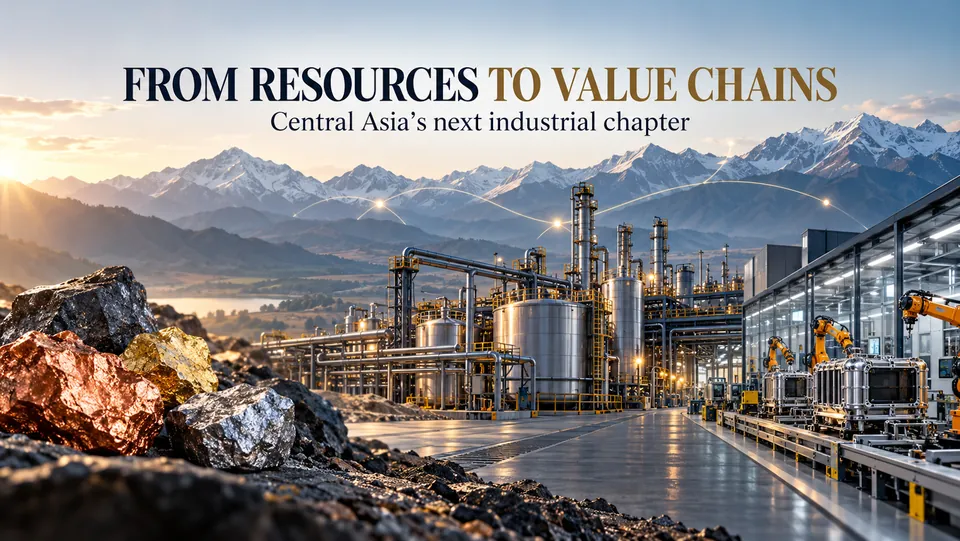
For many years, Central Asia has been discussed primarily in terms of its natural resources. Oil, gas, uranium, metals and minerals have always been part of the region’s economic relevance. What is becoming increasingly interesting, however, is that the discussion is beginning to move beyond the question of what can be extracted and exported. The more important question is becoming: what part of the industrial value chain can remain in the region?
A number of developments over the past few weeks illustrate this shift particularly well.
On 17 September, Uzbekistan Technological Metals Complex — TMK — held a roadshow in Berlin focused on critical minerals and industrial cooperation. According to TMK, representatives of around 20 German industrial companies, end users and financial institutions participated. What caught my attention was not simply the size of the project portfolio presented — more than 140 investment projects with a total value of approximately USD 4.2 billion — but the way the objective was formulated. The stated intention is not merely to increase exports of raw materials or semi-finished products. TMK is looking to attract technologies and manufacturing expertise, localise them in Uzbekistan and develop higher-value production around the country's mineral resources. That is a fundamentally different industrial proposition.
A similar direction was visible only one day earlier on a much broader regional level. At the first Korea–Central Asia summit, South Korea and the five Central Asian countries placed critical minerals, energy and supply chains at the centre of their discussions. More than 70 agreements and memoranda were concluded across areas including mining, energy, infrastructure, technology and investment. Particularly noteworthy was South Korea's emphasis on cooperation extending beyond the supply of raw materials towards the entire critical-minerals value chain — from exploration through processing to final manufacturing.
The bilateral talks with Kazakhstan showed the same pattern. Cooperation was discussed not only around mineral supplies, but also around nuclear energy, science, technology and the development of mineral resources using Korean industrial capabilities. These developments should not be seen in isolation. Europe has been moving in a similar direction for some time. The EU's strategic partnership with Kazakhstan explicitly covers raw materials, refined materials, batteries and renewable hydrogen value chains. With Uzbekistan, the EU signed a memorandum on critical raw materials in 2024, with the stated objective of developing sustainable local value chains alongside secure access to strategically important materials. International Partnerships
Taken together, a larger picture begins to emerge. Central Asia is increasingly becoming relevant not simply because it possesses resources, but because governments and industrial institutions in the region are trying to build industrial capability around those resources. And this changes the opportunity for European industrial companies. If a country primarily exports raw materials, the commercial opportunity is concentrated around extraction, mining equipment and logistics. Once processing, refining and manufacturing are increasingly localised, a much broader industrial ecosystem begins to develop around them. That ecosystem requires process technologies, pumps and valves, filtration, automation, measurement technology, engineering, water treatment, energy infrastructure, specialised materials, maintenance, industrial services and many other capabilities that European industry has developed over decades. But there is another important point. Having the technology does not automatically mean participating in these emerging value chains. The projects are becoming larger, the stakeholder structures more complex and the expectation of local industrial participation stronger. A company therefore has to understand not only where demand exists, but how the emerging industrial structure actually works, which projects are real, who the relevant actors are, which form of cooperation is appropriate and where its own technology genuinely fits. This is where I believe the discussion about market entry has to evolve.
For many companies, international expansion is still thought of primarily as an export question: find a distributor, identify customers, participate in a trade fair and sell equipment. That will continue to work in many situations. But the developments we are currently seeing in Central Asia increasingly point towards something broader. For European companies, the opportunity may therefore no longer be simply to sell into Central Asia, but to become part of the industrial development taking place there. And for Central Asian companies, the opposite question becomes equally important: how can local resources, manufacturing capability and new industrial products be connected with European technology, customers, partners and markets?
This is precisely why I increasingly see the economic relationship between Europe and Central Asia as a two-way industrial development process, rather than a traditional one-directional export corridor. The raw materials may provide the starting point. The much larger opportunity could lie in what is built around them.
At AETEK, this is the perspective from which we look at industrial business development between Europe and Central Asia: not only identifying where demand exists, but understanding where new value chains are forming and how companies can become part of them.
From resources to value chains. From market potential to business.